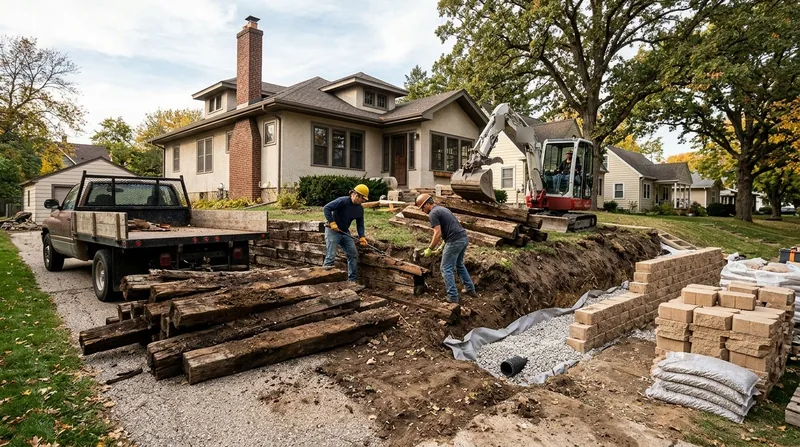




If you own a home in Madison, there is a good chance your property has an aging railroad tie wall holding back a slope, a driveway, or a lakeside yard. Many of these walls went in during the 1980s and 1990s, when creosote-treated ties were cheap and widely used across the Isthmus and the hilly neighborhoods around Lake Mendota and Lake Monona. Today, those ties are rotting, leaning, and in some cases collapsing. Railroad Tie Wall Replacement in Madison means removing the old creosote timber, hauling it away legally, and rebuilding the wall with segmental block, poured concrete, or Wisconsin limestone that will handle our freeze-thaw cycles. We handle the demolition, the drainage, and the rebuild. If your wall is already leaning or has partially failed, see our leaning and collapsed wall repair page first, because safety comes before replacement.
Why Railroad Tie Walls Fail Faster in Madison Than Anywhere Else
Madison sits on glacial drumlins and moraine ridges between two lakes, and that geography is hard on timber walls. The silty loess over glacial till holds water, the water table near the lakes and marshes stays high, and our deep freeze-thaw winters push frost heave into every wall footing. Creosote-treated ties were never designed for that combination, and after 30 years most are rotting from the inside out.
- Frost heave lifts and rotates ties out of line every winter, and the wall never settles back straight.
- Creosote breaks down over time, so the ties soften and lose the structural strength they had when new.
- High water tables near Lake Mendota, Lake Monona, and the surrounding marshes keep the backfill saturated.
- Original tie walls often had little or no gravel drainage, so hydrostatic pressure builds up behind them.
- Rotting ties attract carpenter ants and termites, which then move toward the house.
In lakeside neighborhoods like Tenney-Lapham and Marquette, we routinely find tie walls that are 40 percent rotted and still holding back a saturated slope, which is a genuine hazard.
Key info: A tie wall on a walkout lot in Nakoma or Westmorland that has started to bow is not just an eyesore. Once the ties rot through, the wall can fail suddenly after a heavy rain, and the slope above it goes with it.
For the permit side of any wall project, the City of Madison Building Inspection Division is the authority to check with, and thresholds for engineered drawings vary by wall height and surcharge. You can review their requirements at cityofmadison.com/building-inspection.
How We Replace a Railroad Tie Wall in Madison, Step by Step
Replacing a tie wall is demolition work before it is construction work. The old ties are heavy, creosote-soaked, and often pinned or deadmen-anchored into the slope, so we plan the removal before we touch the wall. We also check access, because many Madison lots in Vilas and University Heights have narrow side yards where a machine cannot fit.
- We walk the site with you, measure the wall, check the slope above and below, and confirm where the property line sits.
- We pull permits where the wall height or surcharge requires it and arrange for utility locates before any digging.
- We excavate behind the wall line and inspect the soil, the footing, and any buried drainage that failed.
- We install new compacted gravel backfill, filter fabric, and a perforated drain pipe daylighted at the low end.
- We build the new wall in segmental block, poured concrete, or Wisconsin limestone, with proper base embedment below frost depth.
- We backfill in lifts, compact, and restore the grade, the lawn, and any plantings we had to move.
Every step is documented, and we do not bury a failed drain behind a new wall.
Key info: On a recent job in Monona, a 1990s tie wall along a lake-facing slope had no gravel behind it at all, just clay. We replaced it with segmental block, added a full drainage bed, and daylighted the outlet below the slope. That drainage work is what keeps the new wall straight through the next 30 winters.
If your project is in the 53716 area, our Monona retaining wall page covers the local conditions in more detail.
Replacement Approaches We Use for Old Tie Walls
Not every tie wall should be rebuilt the same way. The right approach depends on the height of the wall, what it is holding back, how much room you have, and the look you want next to a 1920s foursquare or a 1960s ranch. Here is how the main options compare.
| Approach | Description | Best for |
|---|---|---|
| Segmental block replacement | Old ties come out, new gravel and drainage go in, and a pinned block wall goes up in the same footprint. | Most residential tie walls up to 6 feet, especially in Fitchburg and Sun Prairie subdivisions. |
| Poured concrete replacement | A formed concrete wall with rebar and a proper footing replaces the timber, with drainage behind it. | Tall walls, walls under driveways, and walls that need to carry a surcharge. |
| Wisconsin limestone rebuild | Buff limestone or fieldstone replaces the ties and matches the older masonry found around the Isthmus. | Historic homes in Marquette and University Heights where appearance matters. |
| Boulder and natural stone | Large rock is set into the slope to replace the failed timber and hold the grade. | Lakeside slopes and wooded lots in Nakoma and Maple Bluff where a natural look fits. |
| Partial tie replacement with drainage retrofit | Rotted sections are replaced, and new gravel and drain pipe are added behind the remaining sound ties. | Short walls with limited rot where a full rebuild is not yet necessary. |
We will tell you honestly which of these fits your wall, and we will not sell a full rebuild when a drainage retrofit will buy you another decade.
For a closer look at the block option, see our block and segmental retaining walls page.
Railroad Tie Wall Replacement Cost in Madison: What to Expect
Most railroad tie wall replacements in Madison start at From $35 per square foot of wall face, and that figure covers demolition, creosote haul-away, new gravel backfill, drainage, and the new wall. The final number moves with wall height, access, and material. A 3-foot wall along a flat Verona backyard is a very different job from a 6-foot wall on a tight slope in Shorewood Hills.
- Wall height and length drive the square footage, and anything over 4 feet may need engineering and a permit.
- Access matters: a narrow side yard in Vilas means hand-carrying ties and material, which adds labor.
- Creosote disposal is a real cost, because treated ties cannot go in a standard dumpster.
- Drainage conditions behind the wall can add excavation and a new drain line.
- Material choice moves the price most: block is mid-range, poured concrete and limestone run higher.
Get two or three written estimates and compare what is actually included, especially the drainage and the disposal, because a low bid that skips those is not a real comparison.
Our full pricing overview breaks down the ranges by wall type and size.
Railroad Tie Wall Replacement Near Me: How to Choose a Contractor Near Madison
Hiring for a tie wall replacement is not the same as hiring for a small repair. The contractor has to handle treated wood disposal, drainage design, and often a permit, so ask direct questions before you sign anything. A good contractor will welcome them.
- Confirm the company is fully insured, and ask for the certificate before work starts.
- Get at least two or three estimates in writing, with the scope spelled out line by line.
- Ask for references from jobs in Madison or a nearby city, and call them.
- Ask who pulls the permit, and confirm the contractor knows the City of Madison wall thresholds.
- Check HOA rules in newer subdivisions like those in Sun Prairie or DeForest before choosing a wall material.
- Ask where the creosote ties go, because responsible disposal is part of the job.
If a contractor cannot answer the disposal and drainage questions clearly, keep looking.
Ready to get a number for your wall? Reach out through our contact page and we will set up a free on-site estimate.
Railroad Tie Wall Replacement in Madison: Pricing Guide
| Service | Price | Details |
|---|---|---|
| Partial tie replacement with drainage retrofit | Starting at $35/sq ft | Includes rot removal, new gravel and drain pipe behind remaining sound ties, and disposal. |
| Full tie wall replacement in segmental block | Starting at $45/sq ft | Covers tie demolition, creosote haul-away, new drainage bed, and a pinned block wall. |
| Full replacement in poured concrete or limestone | Starting at $60/sq ft | Includes formed concrete or Wisconsin limestone, footing, rebar, and full drainage behind the wall. |
| Tall or engineered wall (over 4 ft) | On estimate | Height, surcharge, and permit drawings change the scope, so we need an on-site look first. |
| Travel | Included | In Madison and surrounding areas, no separate call-out or mileage fee. |
| Estimate | Free | Response within 24h at (608) 910-8974, no obligation to book. |
Indicative pricing, the exact cost depends on square footage, finish, and site access. Free personalized estimate within 24h at (608) 910-8974.


