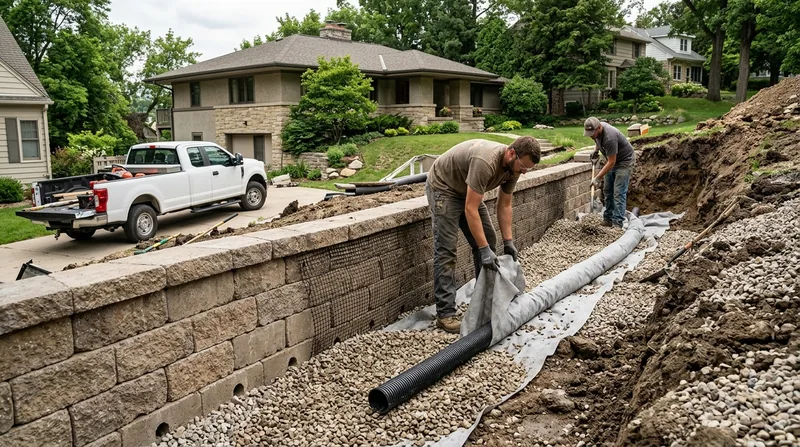




Retaining Wall Drainage in Madison is not a side detail, it is the difference between a wall that holds for decades and one that leans out after three winters. Madison sits on glacial drumlins and moraine ridges between Lake Mendota and Lake Monona, so lakeside slopes, hilly front yards and walkout lots push water straight at the back of every wall. That silty loess over glacial till holds moisture, and the high water table near the lakes and marshes means hydrostatic pressure builds fast behind block, limestone and poured concrete. Add deep freeze-thaw cycles and frost heave, and water becomes the number one cause of wall failure in this city. We build drainage systems that relieve that pressure: drain tile, weep holes, gravel backfill and waterproofing. If your wall is already moving, start with leaning and collapsed wall repair before the damage spreads.
Why Drainage Decides Whether a Madison Wall Survives
In Nakoma and Westmorland, the curving wooded streets sit on slopes that shed water toward the foundations below. In Tenney-Lapham and Marquette, 1900s foursquares and bungalows often have old fieldstone or timber walls with no working drain behind them. The soil is silty loess over glacial till, and near the lakes and marshes the water table stays high. When water cannot escape, it pushes the wall out, freezes, and jacks it forward another inch every winter.
- Water saturates the backfill and adds hydrostatic load the wall was never designed to carry.
- Frost heave lifts and rotates wall caps and the top courses of block and stone.
- Weep holes clog with silt and stop relieving pressure, so water finds the weakest joint.
- Timber and railroad tie walls rot faster when they sit in wet soil year round.
- Poor drainage undermines the footing and starts settlement under the base course.
Every one of those failure modes traces back to water, and every one is preventable with the right drain detail.
Key info: A Hill Farms ranch on a walkout lot had a segmental block wall bulging 2 inches after two wet springs. The culprit was clay-heavy backfill with no drain tile, and the fix was regrading, gravel backfill and a proper outlet, not a new wall.
For official guidance on wall heights, permits and engineered drawings, check the City of Madison building inspection pages at cityofmadison.com before you schedule work.
How We Relieve Water Pressure Behind a Madison Retaining Wall
We start by finding where the water actually comes from: roof downspouts, uphill grade, spring seepage or a high water table near the lakes. Then we open the wall or the backfill, correct the grade, and rebuild the drainage path so water exits instead of sitting. On older fieldstone and limestone walls in University Heights and Vilas, that often means repointing and restoring the face while we add modern drainage behind it.
- We inspect the wall face, footing and backfill, and check for movement, clogged weep holes and settlement.
- We dig out failed backfill and install perforated drain tile at the footing with a gravel envelope.
- We set weep holes at the low points and add filter fabric so silt does not clog the system.
- We waterproof the wall back face where the wall is below grade or holds a surcharge.
- We regrade the top and redirect downspouts and surface water away from the wall.
- We restore the wall face, caps and landscaping, then test the system with a water run.
On a Westmorland Period Revival property, we tied a new drain line into the yard outlet and stopped a wall that had been creeping out of line for years.
Key info: A lakeside wall in Monona was holding a saturated slope with no outlet. We added drain tile, gravel backfill and weep holes, and the wall has stayed plumb through three freeze-thaw seasons.
If the wall is already failing, pair drainage with retaining wall repair so the structure and the water fix happen together.
Drainage Methods We Use on Madison Walls
The right method depends on wall type, slope and how much water the site carries. Buff Wisconsin limestone and fieldstone, poured concrete, segmental block and aging timber all need drainage, but the detail changes with the material and the grade above it.
| Approach | Description | Best for |
|---|---|---|
| Drain tile and gravel backfill | Perforated pipe at the footing wrapped in washed gravel and filter fabric | Segmental block and poured concrete walls on slopes |
| Weep holes and face drains | Openings at the base that let trapped water exit the wall face | Fieldstone, limestone and older masonry walls |
| Waterproofing membrane | Coating or sheet membrane on the back face below grade | Walls holding a surcharge or sitting against a foundation |
| Surface regrading and downspout rerouting | Moving roof and yard water away before it reaches the wall | Hilly front yards and walkout lots |
| Timber wall drainage retrofit | Cleaning out rot-prone backfill and adding drain behind old ties | Aging railroad tie and timber walls |
We match the method to the wall and the water, not to a one-size template.
Retaining Wall Drainage Cost in Madison: What to Expect
Most drainage work in Madison starts around $2,500, and that figure covers a typical residential wall with drain tile, gravel backfill, weep holes and regrading. The price climbs with wall length, how deep the excavation has to go, and whether the wall is already moving and needs structural repair at the same time. Access matters too: a tight lot in Marquette or Vilas costs more to work than an open yard in Sun Prairie.
Water table depth near the lakes, the amount of failed backfill to remove, and whether an engineered detail is required all move the number. Get two or three written estimates so you can compare scope, not just price. Our full pricing overview breaks down the ranges in more detail.
Retaining Wall Drainage Near Me: How to Choose a Contractor Near Madison
Ask for proof of licensing and insurance before anyone touches your wall, and get a certificate sent to you directly. Get at least two or three estimates in writing, and check references from jobs in Madison, Middleton or Fitchburg with similar slopes and wall types. Ask who pulls the permit if the wall is above roughly 4 feet or supports a driveway or structure, and confirm the contractor knows the local building department rules.
If your property is in an HOA or a historic district, confirm approval requirements before work starts. A contractor who has worked the lakeside slopes and the Isthmus lots will spot drainage problems faster. Reach out through our contact page to schedule a free estimate.
Retaining Wall Drainage in Madison: Pricing Guide
| Service | Price | Details |
|---|---|---|
| Drain tile and gravel backfill | Starting at $2,500 | Covers drain tile, washed gravel, filter fabric and outlet for a typical residential wall |
| Weep holes and face drainage | Starting at $2,500 | Adds weep holes and face drains on fieldstone, limestone or older masonry walls |
| Full drainage retrofit with regrading | Starting at $4,500 | Includes backfill removal, waterproofing and regrading on longer or deeper walls |
| Complex or large-scale job | On estimate | Tiered walls, high water table or structural repair need an on-site look first |
| Travel | Included | In Madison and surrounding areas, no separate call-out or mileage fee |
| Estimate | Free | Response within 24h at (608) 910-8974, no obligation to book |
Indicative pricing, the exact cost depends on square footage, finish, and site access. Free personalized estimate within 24h at (608) 910-8974.


